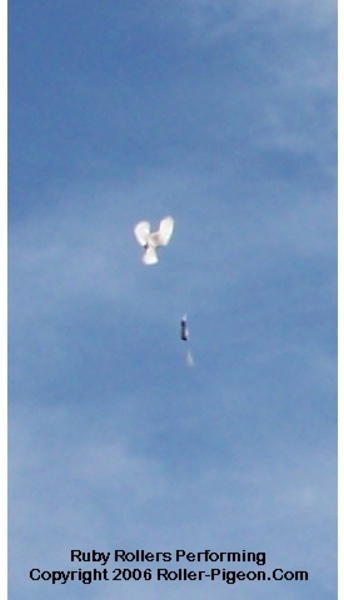
Stable Rollers Are Quality Rollers
In the first years of developing my family of Ruby Rollers, I would see my share of birds crash; hitting objects especially when flying at lower altitudes such as when coming into land. I saw what I thought would be good rollers, destroying themselves as they where not bred, through my own ignorance, to demonstrate rolling “stability”, aka “control”.
Often these birds were spinning with the proper velocity but when they would strike an object: ground, roof, loft, telephone pole, tree, they would either destroy themselves or be seriously hurt with broken wings and legs, swollen heads and bloody eyes.
However, I also noticed that there were other rollers that seemed to be able to master this urge to roll when flying low or coming in to land. I began to see more value in these kinds of birds as time went on. They were easier to work with and produced a more satisfying result.
So at least initially and out of compassion for the birds, I began selecting rollers that demonstrated “control” for use as my breeding stock, happily, I was soon rewarded by seeing a favorable trend in the stability in my birds. Needless to say, I kept on with this process of selecting deep and stable rollers for breeding.
Stable rolling ability is a critical factor in developing a good family of Birmingham Rollers. Here is a list of what to watch for in stable rollers:
• They are active performers (not seldom)
• Depth of roll is notable
• They do not roll down
• As they come closer to land, they shorten the roll, tumble or not roll at all
• Accidents are rare and may be due more to health, conditioning and improper feeding
I should say, it is generally known that a family of rollers that produces deep and high velocity spinners is going to get birds that rolldown, expect it. The challenge is to keep this kind to a minimum by proper breeder selection. Using the most stable rollers in a breeding program is the wise decision and will pay dividends later. I would challenge the newcomer and perhaps the fancier of a few years experience that if you are not consistently producing high velocity rollers of at least 20 to 30 feet that demonstrate control of the roll, then you seriously ought to consider moving onto a bloodline that can. An outcross is a legitimate option.
If you have any doubt, here is some food for thought, it costs just as much to house and feed lousy rollers as it does a quality family. It takes just as much of your limited time to properly train poor rollers (maybe more?) as it does a kit of quality birds. Should you have any lingering doubt about what you should do, simply ask what your money, time and efforts are worth to you. If things don’t add up, then it may be time to find better ones to invest yourself and resources into.
The roller fancier who unwittingly breeds from unstable rollers will find his time full of disappointment and frustration and if a solution is not found, will probably end up quitting the hobby out of frustration. The challenge to maintain and improve a family of quality performing Birmingham rollers is very rewarding when we make proper breeder selections and we see our efforts payoff as the months and years tick by.
For those who intend a lifelong hobby, the most enjoyment will come to those that cultivate a family of active and stable performers of their own which will bring long-term satisfaction and fun. END
Tony Chavarria
|
